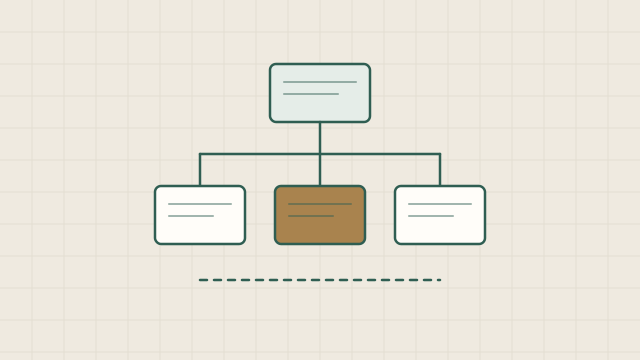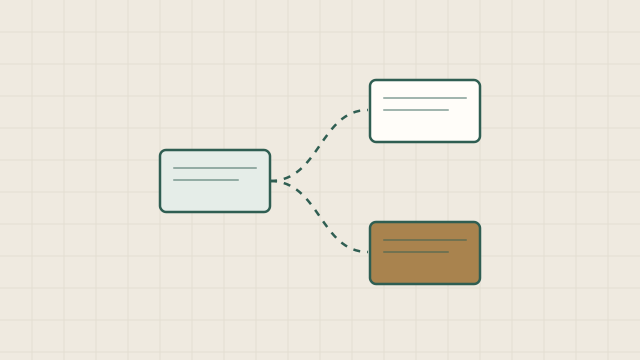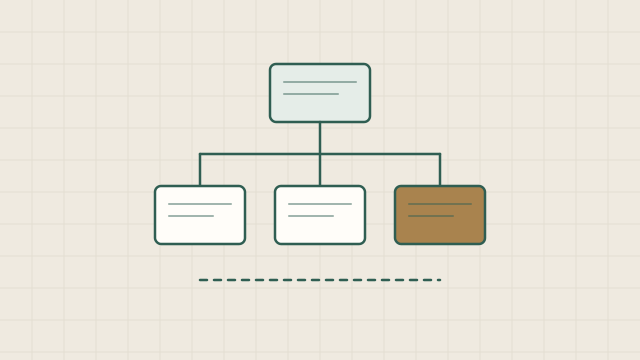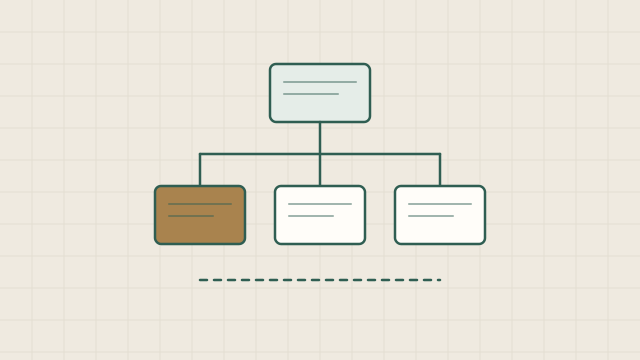
Under the Dutch participation exemption, your holding company pays no corporate income tax on dividends and sale gains from a company in which it holds at least 5% of the shares. Profit from your operating company can therefore move up to your holding without further tax, and you can reinvest it there. Personal tax in box 2 only becomes due when you take the money out privately.
How the Dutch participation exemption works
A Dutch BV (private limited company) pays corporate income tax on its profit. Without an exemption, the same profit would be taxed a second time when the operating company pays a dividend to the holding above it. The participation exemption, known in Dutch as the deelnemingsvrijstelling, prevents this. Profits and losses from a qualifying shareholding are left out of the holding's taxable profit.
Your holding has a qualifying participation if it owns at least 5% of the nominal paid-up share capital of a company. A few other situations count too, such as membership of a cooperative, but for most entrepreneurs it is about the shares in their own operating company. The exemption covers the dividends the operating company pays to the holding and the gain when the holding sells the shares of the operating company.
It also works the other way round. A loss on the sale of the participation is not deductible, and neither are the costs of buying or selling one, such as advisory and notary fees. If your stake drops below 5% after you have held it for more than a year, the exemption continues for another three years.
Between two Dutch companies, no 15% dividend withholding tax has to be deducted on such a dividend either.
Worked example: moving profit tax-free to your holding
Your operating company makes € 300,000 profit in 2026. It pays 19% on the first € 200,000, which is € 38,000, and 25.8% on the remaining € 100,000, which is € 25,800. After € 63,800 of corporate tax, € 236,200 is left.
If the operating company pays that amount to your holding, the holding pays no tax on it. The full € 236,200 is available in the holding to invest, buy property or put into a new business.
Without a holding, if you pay the same amount out to yourself in 2026 as a single person, you pay € 68,747 in box 2, the Dutch tax on income from a substantial shareholding (24.5% on € 68,843 and 31% on the rest). You keep € 167,453. With a holding, that € 68,747 stays invested. Other income and tax credits are left out of this example.
On a sale the difference is larger still. If your holding sells the shares of the operating company for € 1,500,000 while they are on its tax balance sheet at € 100,000, the gain of € 1,400,000 is exempt. Had you held the shares personally, the same gain would have cost € 429,525 in box 2. Set up the holding well before any sale and for a sound business reason, though, or the tax authority can refuse the relief for transferring your shares into it. Our article on selling your business covers the order of steps.
The participation exemption defers tax. Once you take the money out of the holding privately, box 2 is still due. The benefit lies in time and in choosing the moment.
When the exemption does not apply: portfolio participations
The exemption is meant for business interests. If your holding keeps a stake only to earn a normal investment return, it can be treated as a portfolio participation. That is not the case if the subsidiary's business is in line with your holding's own business, or if the holding performs a real management or financing role for the group. A subsidiary that mainly holds stakes of less than 5%, or mostly finances the group, always counts as a portfolio participation.
Even then, the exemption can still apply. It does if the subsidiary is subject to a profit tax that results in a realistic levy by Dutch standards, for which the Dutch tax authority uses a rate of 10% as a rule of thumb, or if less than half of its assets consist of low-taxed free portfolio investments. A Dutch investment company under your holding simply pays Dutch corporate tax and passes the first test, so dividends from that company to your holding are exempt. There is more on this in our article on investing through a BV.
If a portfolio participation fails both tests, the exemption is replaced by a credit system. You include the income in your profit grossed up by 100/95 and may credit at most 5% of that amount. In practice you then pay mostly ordinary corporate tax on that income.
Foreign subsidiaries
The participation exemption also applies to subsidiaries abroad, with the same 5% threshold. A foreign subsidiary that runs a real business qualifies even if it pays little tax locally, because the realistic levy test only matters for portfolio participations. Payments the subsidiary can deduct itself, such as interest on certain hybrid loans, are not covered by the exemption.
If you live in the Netherlands and run the foreign company from here, that company is often resident in the Netherlands for corporate tax purposes anyway. On top of that, the Dutch rules on controlled foreign companies can tax the passive income of a low-taxed subsidiary at the level of your holding. Whether a foreign subsidiary really stays outside Dutch tax therefore depends on its substance on the ground, for example with a Hong Kong Limited.
Participation exemption or fiscal unity
If your holding owns at least 95% of the shares in the operating company, you can also apply for a fiscal unity. The tax authority then treats the companies as a single taxpayer with one return. The main advantage is that losses in one company are offset directly against profit in the other. Dividends between the companies no longer matter within a fiscal unity.
There is a downside as well. Outside a fiscal unity, each company has its own € 200,000 band taxed at 19%. Within a fiscal unity, the whole group shares that one band. If two companies each make € 150,000 profit, they pay € 57,000 together as separate taxpayers and € 63,800 as a fiscal unity. The participation exemption already works from 5% and needs no application, so for a healthy operating company under a holding it is usually enough. A fiscal unity is mainly worth it when one of the companies is making a loss.
When a holding with the participation exemption pays off, and when it does not
It pays off when your operating company earns more than you need privately, when you want to reinvest or invest that profit, and when you may sell your business one day. The holding also shields the reserves you have built up from the risks of the operating company.
It pays off less if you take almost all profit out privately every year. You pay box 2 regardless, and the holding mainly adds an extra set of books and annual accounts. Our article on setting up a Dutch holding sets out the costs and the structure.
Frequently asked questions
From what percentage does the participation exemption apply?
From 5% of the nominal paid-up capital of the company. If your stake falls below 5% after you have held it for more than a year, the exemption continues for another three years.
Does my operating company have to withhold dividend tax when it pays my holding?
No. On a dividend from a qualifying participation between two Dutch companies, the paying company does not have to withhold dividend tax.
Does the participation exemption apply to a foreign subsidiary?
Yes, with the same 5% threshold. If the subsidiary mainly holds investments, additional tests apply, and for a low-taxed subsidiary the controlled foreign company rules can also come into play.
Is a sale gain through my holding permanently tax-free?
Within the holding it is, but once you take the money out privately you pay box 2. The exemption gives you deferral and the choice of when to settle.
Can my holding deduct the costs of a sale?
No. Costs of buying or selling a participation are not deductible, just as a loss on the participation is not deductible.
In a free advisory call we look at your current structure and check whether the participation exemption works in full, including for any foreign subsidiaries. We calculate what a holding would do for you at your level of profit and with your plans to reinvest or sell, and we will tell you plainly if a holding does not pay off in your case.
Sources
- Belastingdienst: Deelnemingsvrijstelling
- Belastingdienst: Deelnemingen
- Belastingdienst: Wanneer is een deelneming een beleggingsdeelneming
- Belastingdienst: Kwalificerende beleggingsdeelneming
- Belastingdienst: Deelnemingsverrekening
- Belastingdienst: Beleggingen
- Belastingdienst: Fiscale eenheid vennootschapsbelasting
- Belastingdienst: Tarieven vennootschapsbelasting
- Belastingdienst: Ontvanger dividend in nederland vrijstelling dividendbelasting
- Belastingdienst: Aanmerkelijk belang
Last checked on 6 Nov 2026.